
Why Did a Twitter Poll Do What Three Years of Pitch Decks Couldn't?
I traced 128 category names across eight sectors. every survivor follows one structural rule.

The product never got discussed because the category consumed the air.
For three years I worked inside a category that did not have a name. Mysterium Network. Decentralized VPN. Peer-to-peer bandwidth sharing, token-incentivised, users routing traffic through other users so no single company controlled the pipes. I was CMO from 2018 to 2021 and during that time I described what we were building in a different sentence every week. The sentence changed depending on who was in the room. VCs needed one version. Journalists needed another. The website said something else entirely.
The problem was never the product. The problem was that the thing we were building, and the thing Filecoin was building, and the thing Helium was building, and the thing Hivemapper was building, had no collective noun. Each project pitching a different metaphor to a different fund, each hoping someone in the room would understand the architecture without having to be taught it from first principles. I spent conference after conference watching the same twelve-minute explanation happen. What is it. How does it work. Why would anyone use it. By the time you had answered those three questions, the meeting was over.
Then in November 2022 a research firm called Messari posted a Twitter poll. “Web3 physical infrastructure needs a name.” Four options. DePIN won with 31.6% of the vote.

A Twitter poll named a category that now contains over 650 projects.
The twelve-minute explanation became three seconds. “We’re DePIN.” The fund manager nodded. The meeting moved to the product.
I wanted to know whether what happened to us was a pattern or an accident. So I traced 128 category-defining terms across fashion, tech, food, wellness, finance, real estate, media, and sustainability. Who coined each name. When. How it spread. What structure made it stick. What made the ones that died, die.
Every surviving category name implies its opposite
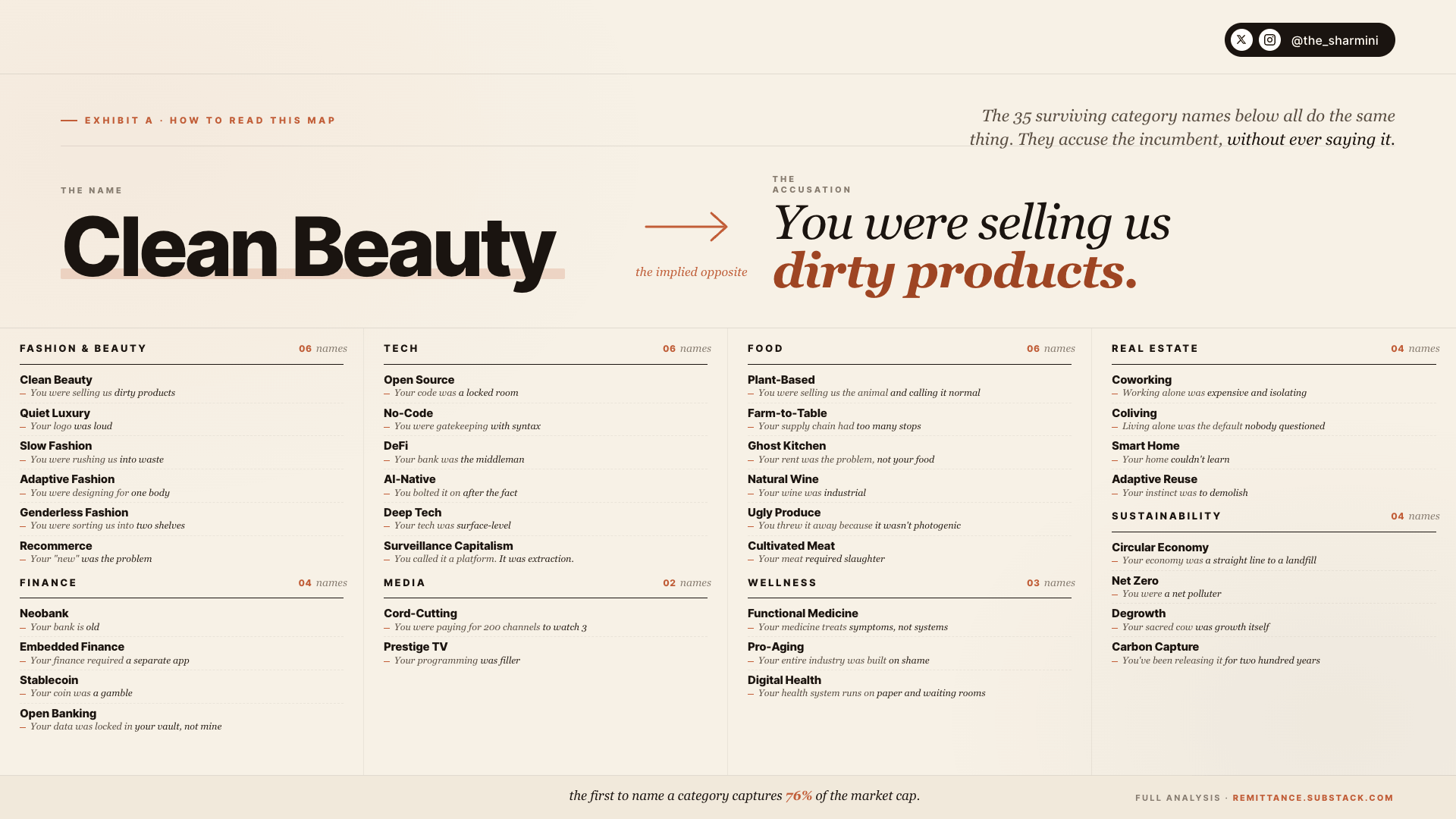
“Clean” beauty made everything else dirty. “Quiet” luxury made the alternative loud. “Plant-based” named the thing it was replacing without saying the word. “Gig economy” implied the opposite of gig work: stable employment, the thing people had lost. The implied opposite is what turns a label into a position. It recruits the audience’s existing resentment and gives it vocabulary. This sounds like a copywriting insight but it is actually a market-structure insight, which is the sort of distinction I used to think didn’t matter until I watched a two-word phrase rearrange an industry.
The names that broke the rule are dead. I counted them.

In 2016, a Danish woman named Ida Tin had the same problem I had. She had co-founded Clue, a period-tracking app. The product worked. The market existed. But there was no word for what she was building. No Crunchbase tag. No conference circuit. No mental shelf investors could place it on. “Women’s health tech” was too long. “Health tech” was too broad. The category was invisible because it was unnamed.
She made up a word. Femtech. She coined it explicitly to make the market legible to investors. She needed a word that would make the space investable, and that is a fascinating sentence if you sit with it, because it means the obstacle to a trillion-dollar market was not regulation or technology or demand. It was that nobody had named the shelf.
Within three years femtech was a Crunchbase category, a conference track, and a market projected to reach $1 trillion. Tin didn’t describe an existing category. She named one into existence. Her brand was the first result when VCs searched the term she had created.
Tin was not the first person to do this. On February 3, 1998, Christine Peterson proposed the term “open source” to replace “free software.” The software was the same. The licence was the same. But “free” was confusing investors, who heard “free” and thought “no revenue model,” which was not what the community meant but was, unfortunately, what the word said. Peterson swapped one adjective and the investment narrative changed. The open source industry exists, in some non-trivial sense, because a single person understood that the obstacle was not the product. It was the word on the front of the product.
The food industry learned the same lesson a different way. For decades the word for not eating animal products was “vegan.” Vegan carried ideology. It carried judgement. It carried a subculture most consumers did not want to join. Then someone started saying “plant-based” instead. Same dietary territory. Different word. “Plant-based” carried aspiration where “vegan” had carried restriction. The adjective swap reframed a choice people resisted into a choice people wanted to make, and Beyond Meat captured 19% of the global burger market on the back of it. Nobody changed the recipe. Somebody changed the name.
HBO premiered Succession’s final season on March 26, 2023. Within weeks the Roy family’s wardrobe had a two-word name that would hit 35 billion views on TikTok. Loro Piana cashmere. The Row blazers. Brunello Cucinelli knitwear. The concept of understated wealth predates every trend piece about it, but the concept did not have a name that could organise a cultural conversation across TikTok, fashion press, and retail simultaneously. Then it did. Google searches for “quiet luxury” spiked 684% after the first episode aired.
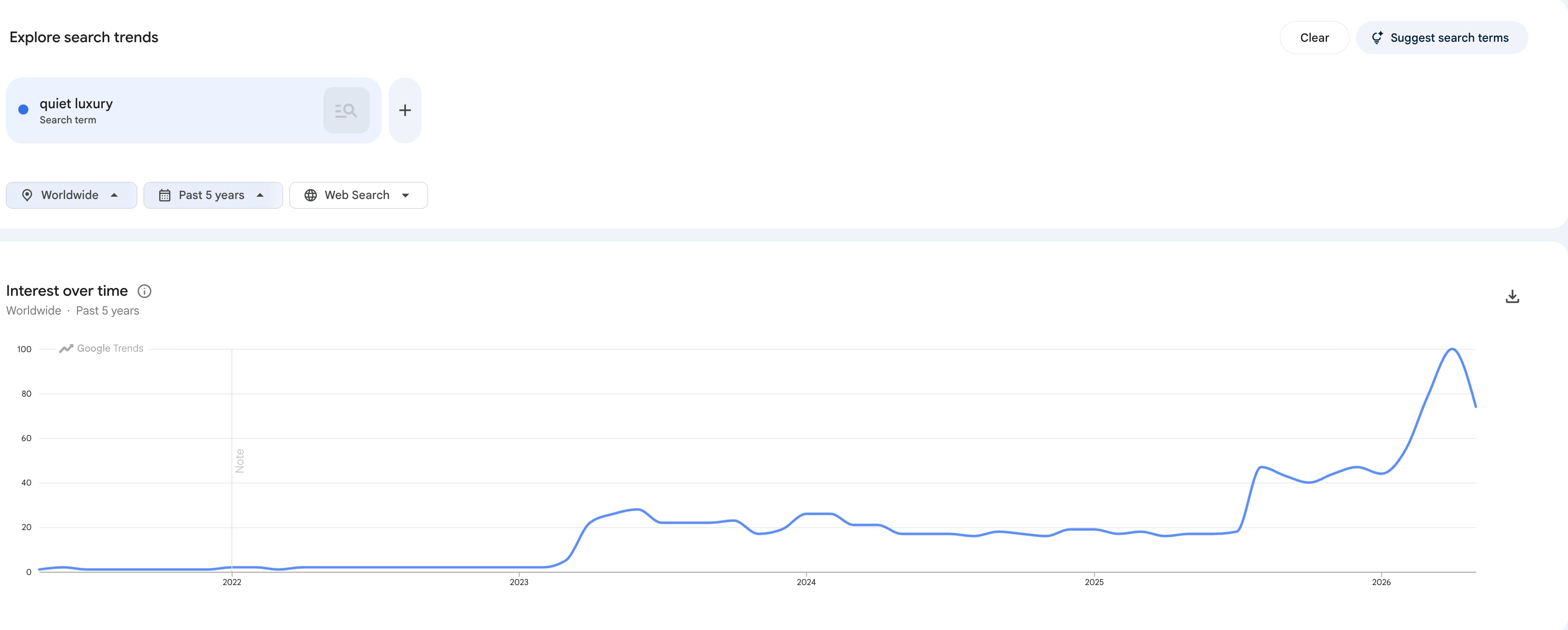
Luxury is supposed to be visible. “Quiet” makes visibility the flaw. The contradiction forces the brain to resolve it, and the resolution is the category.
The word “athleisure” first appeared in print in 1979. It described footwear that looked athletic but was not designed for sport. Then nothing happened. For decades. The word existed. The market did not. It took Lululemon, yoga pants, and a slow cultural shift toward clothes that work in both a gym and a meeting before the word had something to describe. Merriam-Webster added it to the dictionary in 2016. Thirty-seven years from first print to dictionary entry. Compare that with femtech. The difference is that Ida Tin championed the word. Athleisure drifted for three decades until a brand large enough to anchor it happened to exist.
A name without a champion is a word. A name with a champion is a category.
The rule holds across 128 terms but names spread differently in every sector. In sustainability, the name comes down from policy: ESG was coined by a UN team in 2004, net zero entered the Paris Agreement in 2015. In fashion, the name comes up from culture: cottagecore was coined on Tumblr in 2018 and had mainstream retail placement by 2020. In crypto, three people in a Telegram group chat coined “DeFi” in August 2018 because the previous name was too generic, and the word was in use before most people had agreed what it meant.
The category does not care about the dignity of its origin.
Nobody invented clean beauty. The phrase was already in blog posts and ingredient lists by 2015. Goop was using it. Drunk Elephant was using it. Customers were typing it into search bars. The words existed. The category didn’t.
On June 1, 2018, Sephora launched the “Clean at Sephora” seal. Fifty brands. One badge. The language that had been floating in cultural conversation became retail infrastructure overnight. By 2023 the clean beauty market was valued at $8.7 billion. Sephora didn’t have to attack any brand. The seal did it. If your product didn’t carry the badge, you were the opposite of clean.
Sephora did not invent clean beauty.
Sephora formalised it. Messari did not build DePIN. Messari named it. The people who build the thing and the people who name the thing are not the same people, and the namers walk away with the structural advantage. I was a builder. I did not name it. I am not over this.
Not all names survive. The interesting cases are the ones where two names compete for the same market, and one of them simply stops being the word people reach for.
In 2008 Lawrence Lessig used the term “sharing economy” in his book Remix. “Sharing” made platform capitalism sound communal. The industry liked the word because it made extraction feel generous.
On January 12, 2009, journalist Tina Brown published “The Gig Economy” in The Daily Beast. “Gig” came from jazz. A one-off performance. No guaranteed encore. The word carried the economic reality that “sharing” had papered over.
The journalist’s name won. “Gig economy” is now the standard term across policy, press, and public conversation. “Sharing economy” reads like a pitch deck from 2014 that aged in dog years.
The journalist’s name won. Both names described the same market. The products did not change. The platforms did not change. Only the name changed, and the name that survived was the one with the stronger implied opposite. What is the opposite of sharing? Not sharing. That is not a position anyone resents. What is the opposite of gig work? Stable employment. A salary. Benefits. That is a loss people feel in their bank accounts every month. You cannot build a category on a euphemism once the thing it euphemises has been named by someone else.
The first brand to formalise a category name captures 76% of the total market capitalisation in its space.
Play Bigger studied 35 companies.
The name is not the brand. The name is the infrastructure the brand gets built on.
A few names survive without an implied opposite. Doomscrolling. Capsule wardrobe. Farm-to-table. These work because you can picture them instantly. The strongest names do both: imply the opposite and make it visible. Clean beauty makes you see the badge and feel the dirt.
Right now there are phrases in cultural commentary that describe categories nobody has formalised. The words are in the water. Journalists are already pairing them. The markets exist. The names are floating.
I know what it feels like to build inside an unnamed category. I know what changes when the name arrives. I also know, now, that the person who names it is not always the person who builds it, and I have not yet decided whether that is a problem to be solved or a condition to be accepted.
The question for anyone building in an unnamed space is not what to call it. The question is whether someone else names it first.